
managing death is expensive
the dragon we still feed

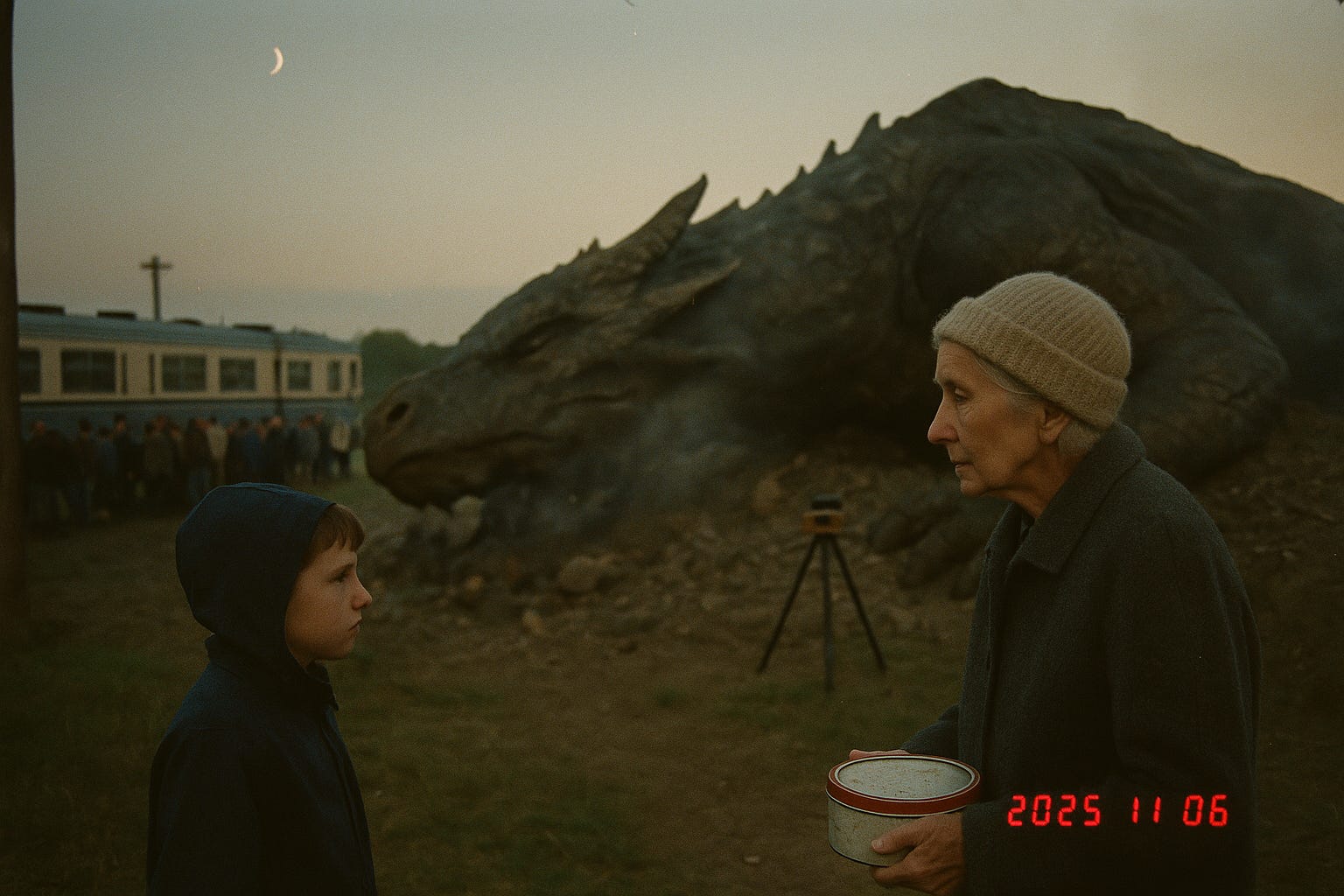
we spend one-seventh of our GDP managing death.
that’s what healthcare is, really. a vast bureaucracy dedicated to making the process of dying slightly more comfortable, slightly less painful, slightly more dignified. we research individual diseases - cancer, alzheimer’s, heart disease, yet we barely study the single thread connecting them all: aging itself.
nick bostrom wrote “the fable of the dragon-tyrant” in 2005. in it, a kingdom lives next to a mountain inhabited by a terrible dragon that demands thousands of lives every day. people become accustomed to this as a fact of life. a large bureaucracy springs up to meet the dragon’s demands, shipping people to the mountain by railway every night. this bureaucracy becomes extraordinarily expensive, consuming one-seventh of the kingdom’s budget.
one day, a sage proposes that it might be possible to kill the dragon if an advanced material could be developed. the kingdom’s intelligentsia dismisses this as wishful thinking. many years later, dragonologists developed this advanced material & started advocating for construction of a weapon.
at a public meeting, the king’s chief advisor for morality argues against killing the dragon. he uses eloquent rhetoric to make the case that being consumed by the dragon is intrinsically part of what it means to be human.
then a young boy shouts: “the dragon is bad!”
the boy explains that the dragon devoured his grandmother, who had promised to bake cookies with him. his guileless statement of simple truth galvanizes the public. then, the king dedicates vast sums to the dragon-killing project. twelve years later, the weapon is ready. they kill the dragon.
the story ends with the king overcome with guilt, realizing how many lives could have been spared had they started earlier.
we are living in that kingdom right now.
i’ve been watching the longevity space closely - attending conferences, speaking with researchers, meeting founders building & investors deploying capital to try & save humanity. what strikes me is how much we sound like the characters in bostrom’s fable.
aging is accumulated biological damage. cellular senescence. telomere shortening. mitochondrial dysfunction. protein misfolding. we’ve been studying the dragon’s eating patterns for decades. now we’re finally developing materials harder than its scales.
but we’re making the same mistakes as the kingdom.
we spend trillions managing the symptoms of aging while dedicating nothing to ending it. the NIH budget for 2025 was $50.1 billion. most of that goes to researching individual age-related diseases. the amount dedicated to understanding & reversing the aging process itself? barely anything.
we listen to bioethicists argue that aging gives life meaning, that we shouldn’t “play god.” these arguments are lifted, almost verbatim, from bostrom’s fictional morality advisor. they sound profound but they’re just elaborate ways of saying we should keep feeding people to the dragon.
the simple truth remains: the dragon is bad because it eats people.
aging is bad because it kills people. not quickly, not cleanly, but slowly & painfully. it strips away memory, mobility, independence, dignity.
what happens when we stop accepting it?
the longevity companies that will define the next decade haven’t even scratched the surface as yet. but the pieces are coming together. AI is accelerating drug discovery by orders of magnitude. synthetic biology is letting us reprogram cells like software. we’re learning to edit genes, grow organs, interface directly with neural tissue.
within 20 years, humans could be radically different. living longer, healthier.
the biological constraints that define human existence could become optional.
but this raises the same questions the kingdom faced: who gets access to the dragon-killing weapon? when biotech can extend healthy lifespan by decades, does longevity become the ultimate luxury good? when some people age at normal rates while others gain decades of health, does economic inequality become biological inequality?
the distinction between treatment & enhancement blurs. a digital twin that prevents diabetes is medicine. a neural interface that downloads skills is enhancement. a bioprinted organ that replaces a failing kidney is treatment. printing a younger version of an aging organ is... what, exactly?
the king’s guilt at the end of bostrom’s fable is haunting.
he realizes how many lives could have been spared had they started earlier. we’re in that same position now. every year we delay serious investment in understanding & reversing aging costs roughly 100,000 lives per day. that’s the dragon’s daily appetite.
we have the tools. AI that can simulate molecular interactions. gene editing that can rewrite DNA. synthetic biology that can reprogram cells. bioprinting that can manufacture tissues.
what we lack is the same thing the kingdom lacked: the simple recognition that the dragon is bad.
whether this leads to human flourishing or creates new suffering remains to be seen. building the weapon is one thing. deciding who gets to use it is another. ensuring it doesn’t create worse problems than the dragon is a third.
but the alternative - continuing to feed tens of thousands of people to the dragon every single day while we debate the philosophy of dragon-feeding seems unconscionable once you see it clearly.
the dragon is bad.
Greetings Mansi, just wanted to drop a comment to mention my appreciation for your work, I enjoy seeing it on my feed.
I write about history, from the perspective of historic books, but with a modern philosophic flair.
Here’s my latest if your interested!
https://open.substack.com/pub/jordannuttall/p/real-accounts-of-mythical-animals?r=4f55i2&utm_medium=ios
Thank you for drawing the parallel between Nick Bolstrom’s fable and today’s issue of mitigating symptoms of aging rather than curing it.